

Professor of Atmospheric Chemistry


Research Overview

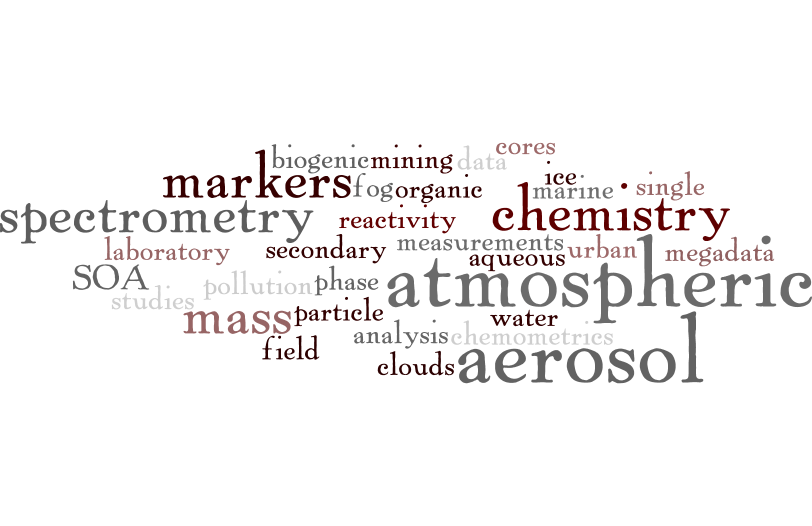
The atmosphere is a multiphase environment in which gases, particles (or aerosols) and fog/cloud droplets interact. Our research explores how the chemistry of aerosols shapes the atmosphere, climate, and human health. We study the molecular-level processes that control how particles form, transform, and interact with gases, clouds, and radiation. Using advanced mass spectrometry, field campaigns, and lab experiments, we connect microscopic phenomena to global-scale environmental impacts.

Our work lies at the intersection of chemistry, climate science, and sustainability — seeking to understand and protect the air we breathe and the planet we share.

Current Research Themes

Atmospheric Chemistry and Climate

We investigate the formation and transformation of aerosols and trace gases that influence radiative forcing, cloud formation, and climate feedbacks.

Air pollution and human health

We investigate how the chemical composition of atmospheric aerosols influences their toxicity in different environments (e.g., urban, volcanic, and indoor).

Indoor Air and Human Exposure

Our group studies the composition and health impacts of indoor aerosols and gases, helping to inform policies for cleaner and safer built environments.

Paleoclimate from Ice Cores

By analysing organic markers trapped in polar and glacier ice, we reconstruct the chemical history of Earth’s atmosphere and its link to past climate change.

Sustainable Agriculture and Climate

We explore how farmland management practices influence greenhouse gas emissions.


Professor Giorio is part of the Centre for Atmospheric Science, the Cambridge Centre for Climate Science, the Centre for Landscape Regeneration, the Centre for Climate Repair, and the Institute of Computing for Climate Science.


Diversity and inclusion statement

A multicultural and diverse research team is an asset to research excellence because it is fueled by diverse experiences, perspectives, and ideas. I value diversity and proactively encourage inclusion by creating a supportive environment and embracing the Athena SWAN principles. I promote and encourage a sustainable work/life balance and flexible working arrangements.

Joining the group

Prospective postgraduate students should apply through the Department of Chemistry Postgraduate Admissions. Prospective postdoctoral researchers are invited to contact Professor Giorio for information on funding that may be available.


Watch Dr Giorio discuss her research

Take a tour of the Giorio lab facilities

Publications

Metal ion release from fine particulate matter sampled in the Po Valley to an aqueous solution mimicking fog water: Kinetics and solubility
V Di Marco, A Tapparo, D Badocco, S D’Aronco, P Pastore, C Giorio
Aerosol and Air Quality Research
(2020)
20
Chemical composition and characterization of aerosols off Namibia: results from the AEROCLO-sA project
P Formenti, D Klopper, S Chevaillier, B D’Anna, K Desboeufs, J-F Doussin, A Feron, C Giorio, MD Mallet, C Mirande-Brét, A Monod, A Namwoonde, S Triquet, S Piketh
(2020)
Solubility of metals in aerosol samples from Mount Etna during the EPL-REFLECT campaign
C Giorio, S D'Aronco, L Soldà, S Giammanco, A La Spina, G Salerno, A Donatucci, T Caltabiano, P Sellitto
(2020)
Small-scale volcanic aerosols variability, processes and direct radiative impact at Mount Etna during the EPL-RADIO/REFLECT campaigns
P Sellitto, G Salerno, A La Spina, T Caltabiano, S Scollo, A Boselli, G Leto, R Zanmar Sanchez, A Sannino, S Crumeyrolle, B Hanoune, C Giorio, S Giammanco, T Roberts, A di Sarra, B Legras, P Briole
(2020)
Microfluidic device for continuous-flow analysis of organics in oldest ice
D FIlippi, C Giorio
(2020)
Effect of metal speciation on the oxidative potential and cytotoxicity of airborne particles
S DAronco, C Giorio, F Chiara, R Seraglia, V Di Marco, A Tapparo
(2020)
Formation of metal-organic ligand complexes affects solubility of metals in airborne particles at an urban site in the Po valley
A Tapparo, V Di Marco, D Badocco, S D'Aronco, L Soldà, P Pastore, BM Mahon, M Kalberer, C Giorio
Chemosphere
(2019)
241
Direct depolymerization coupled to liquid extraction surface analysis high-resolution mass spectrometry for the characterization of the surface of plant tissues
C Giorio, E Moyroud, BJ Glover, M Kalberer
Anal Chem
(2019)
91
Sustainability of using vineyard pruning residues as an energy source: Combustion performances and environmental impact
C Giorio, S Pizzini, E Marchiori, R Piazza, S Grigolato, M Zanetti, R Cavalli, M Simoncin, L Soldà, D Badocco, A Tapparo
Fuel
(2019)
243
Direct injection liquid chromatography high-resolution mass spectrometry for determination of primary and secondary terrestrial and marine biomarkers in ice cores
A King, C Giorio, E Wolff, E Thomas, M Roverso, M Schwikowski, A Tapparo, S bogialli, M Kalberer
Analytical Chemistry
(2019)
91

Group leader

Research Interest Group

Telephone number

01223 336392

Email address

Centre Highlights

• July 2025: The PACESETTERS project launches one of its Real-World Labs (RWL) in Galway, marking a key milestone in the project's mission to connect creative practice with climate transformation. Prof. Annela Anger-Kraavi gives a talk "Where Are We Now?" sharing insights on what's needed to drive meaningful climate transition.

• June 2025: New publication: Compounding injustices can impede a just energy transition

• January 2024: The CCPG have successfully submitted a proposal for PACESETTERS!

• September 2nd 2023: Dr Annela Anger-Kraavi has co-authored a paper analysing just transition narratives in European coal regions. Read the paper here

• December 13th 2022: The CCPG have co-authored a paper on game-changing innovations towards net-zero, published in Energy Strategy Reviews. Read the open access paper here.

• November 15th 2022: The final conference of PARIS REINFORCE is taking place today in Sorbonne. Read more about the event here

• October 24th 2022: The CCPG have successfully submitted a proposal for the Cambridge-Tsinghua joint research initiative! 

• May 5th 2022: We've submitted to the UNFCCC's Global Stocktake (GST). More information is available on our news page. 

• March 23rd 2022: Multiple CAS academics have published a paper investigating the future role of anthropogenic methane emissions. Read the open access paper here.

• Feb 18th 2022: Dr Parris and Dr Anger-Kraavi have co-authored a paper that develops a tool to support co-designed transformative change. Read the open access paper here.

• Dec 16th 2021: Dr Parris has co-authored a paper that introduces a tool to support plastic pollution policy. Read the open access paper here.

• Nov 22nd 2021: Dr Anger-Kraavi has co-authored a paper with Paris Reinforce. Read the open access version here


Want to know more about our high-profile publications? Check out our Publication Highlights!